Peetz Family sues Tallgrass
by Adrienne LaBay
Subscribers can view the online article HERE
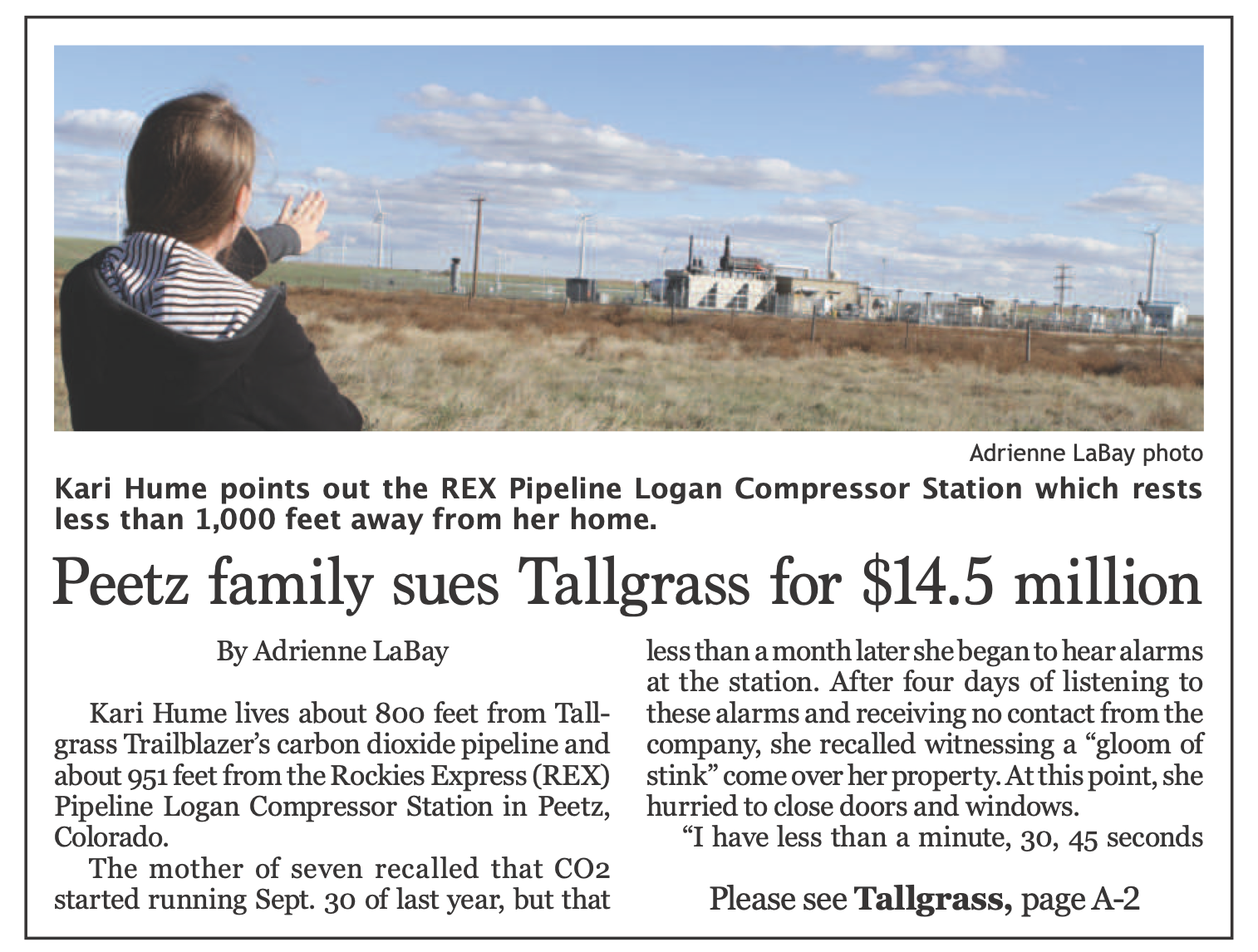
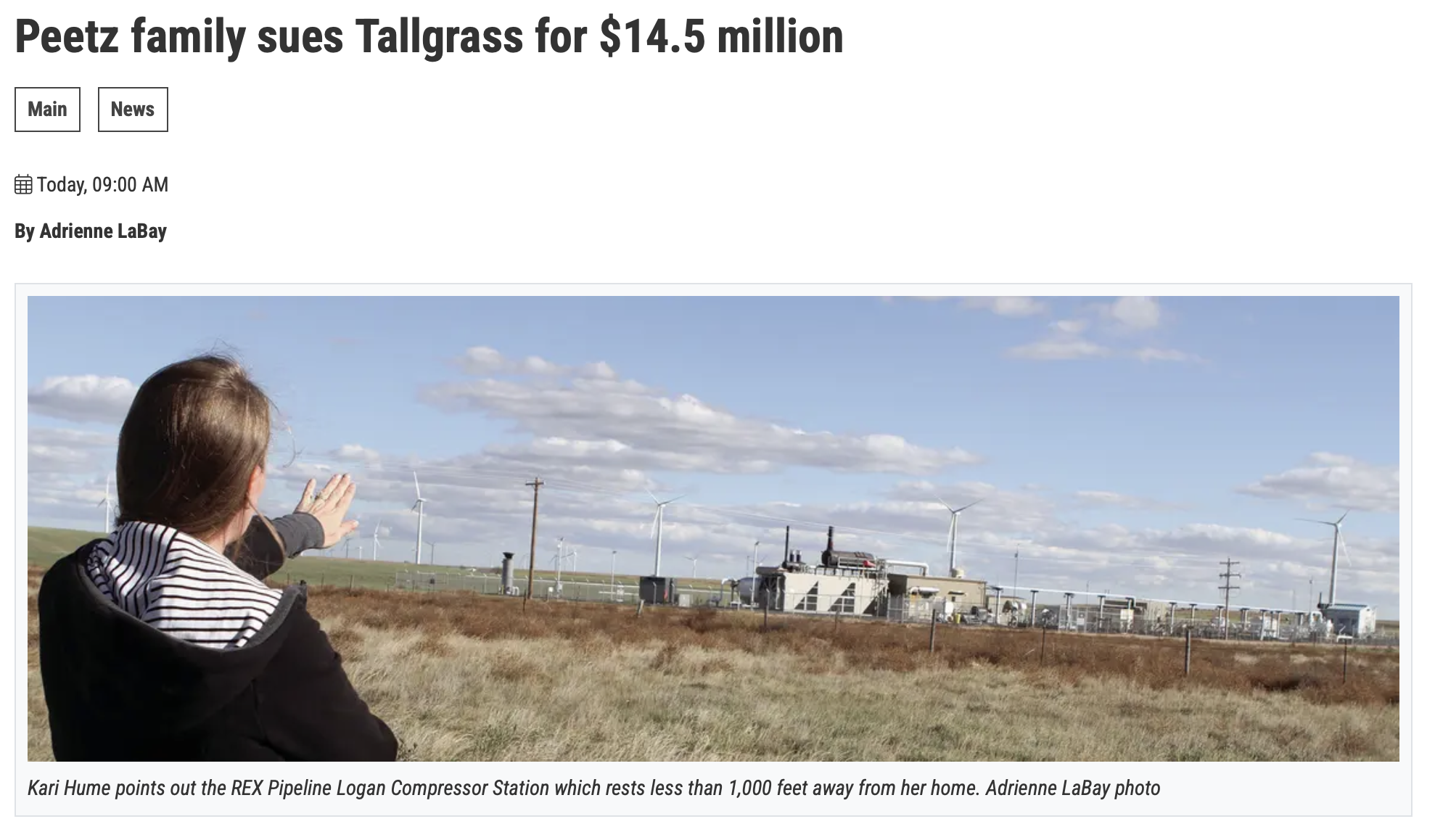
Kari Hume lives about 800 feet from Tallgrass Trailblazer’s carbon dioxide pipeline and about 951 feet from the Rockies Express (REX) Pipeline Logan Compressor Station in Peetz, Colorado.
The mother of seven recalled that CO2 started running Sept. 30 of last year, but that less than a month later she began to hear alarms at the station. After four days of listening to these alarms and receiving no contact from the company, she recalled witnessing a “gloom of stink” come over her property. At this point, she hurried to close doors and windows.
“I have less than a minute, 30, 45 seconds of exposure,” Hume said. “And I end up having my septum swelled into my nose, coughing and postnasal drip. Ten days it took for that to go down.”
Since then, Hume and her family have filed a $14.5 million lawsuit against Tallgrass.
The complaint filed in the Logan County District Court includes seven claims for relief: Trespass and continuing to trespass, unjust enrichment, anticipatory breach of contract, private nuisance, negligence, strict liability- abnormally dangerous activity and declaratory judgement against all defendants.
The breach of contract claim relates to a 1981 easement for the use of a pipeline with Tallgrass Pipeline Company to transport natural gas, created by a previous landowner. This agreement states that should the pipeline no longer be used to transport gas, it be removed from the property. No agreement modifying this one for the transportation of CO2 has been signed.
The contract is also the basis for the claim of trespassing, which leads to the claim for unjust enrichment. This allegation states that the company has benefitted monetarily from use of their land without a valid easement.
The claims for negligence and strict liability are also related to each other, as the claim for negligence alleges that the company has failed to ensure safety by using a pipeline not rated for CO2, failure to properly maintain the old station and failing to implement federally required public-education programs. The strict liability claim states that since the pipeline was not “designed, rated, or certified for CO2 service”, it “constitutes an abnormally dangerous activity.”
The claim for private nuisance alleges that the compressor station emits noise exceeding state and federal limits, pungent odors and harmful emissions, continuous light pollution visible from their bedrooms and a low-frequency vibration.
Finally, the document writes that “declaratory judgment is necessary and appropriate to resolve the parties’ dispute.”
Ultimately, the complaint states the Hume family has suffered damages not less than $14.5 million in net property, business loss and additional damages. Hume said the suit is still in the discovery phase.
A statement released by Tallgrass’s Senior Vice President of Government Affairs, Steven Davidson, said they will not comment on the substance of the allegations or litigate those issues as the litigation is still pending.
That said, Davidson said the safety of employees, landowners and the communities they operate in are their top priority, with constant monitoring from highly trained technicians and multiple layers of protection. Furthermore, he said they work closely with local first responders to ensure they have the training, information and resources needed to respond effectively in the unlikely event of an incident.
Peetz Fire Chief Steven Schumacher confirmed that his department has had pipeline rupture training from Tallgrass for natural gas, but not CO2.
BACKGROUND
An article by the Great Plains Institute published in 2024 states that CO2 pipelines average 4.1 accidents a year and typically cause less property damage than pipeline accidents involving other hazardous materials. However, other incidents have shown just how devastating a rupture can be on a small town, especially if not stopped in a timely manner.
One such notorious incident occurred in Satartia, Mississippi in 2020, where 45 people were hospitalized after a rupture. Though there were no fatalities, many of the survivors continue to face health issues.
“One of the greatest concerns we have is that this pipeline is a unique scenario,” Hume said. “In the event of a significant leak or rupture, you can’t really evacuate. Because it displaces oxygen, vehicles will stall… It’s an asphyxiant to all living things and vehicles, anything that requires air, oxygen.”
Transportation is a key factor that affects anyone living in rural areas, as the distance from towns and cities means help is slower to arrive.
LIVELIHOOD CONCERNS
One unique concern the Hume family has due to the new compressor station is how it has impacted their livelihood. Hume’s husband, Brady Hume, runs Farmstead Fabrications onsite where he creates custom and commercial, components many for electrical substations. Hume said the business has suffered losses due to the compressor station’s proximity to their home for three reasons.
One is attributed to ‘blowdowns’, which the U.S. Environmental Protection Agency states is a period of maintenance where the station is closed and the pipe contents are vented into the atmosphere. As part of his job, Brady works with open air flames through welding and plasma cutting. While CO2 isn’t a danger here, the natural gas running through the compressor station is, because of its flammable properties. “We don’t get notification,” Hume said. “So he’s in the middle of doing that whenever these things are happening.”
Their second concern was the vibrations released by the station. Specifically, Hume described the wavelengths as inaudible, but still felt.
“It thumps in your ears,” Hume said. “You can feel it in your bed. You literally feel it from the inside-out.”
Brady clarified the vibrations did not cause any shaking in his work.
The third reason this has impacted their work is Hume’s plans to move from the area. While the original plan had been to create a multi-generational home, Hume said the presence of the station has made their home uninhabitable.
As such, they are currently unable to take on long-range projects without knowing where they will be in a year’s time, resulting in a loss of work.
…READ ON THEIR WEBSITE by clicking here