ACT NOW - expected vote is November 9th: A new bill has been proposed that threatens our rights and safety.
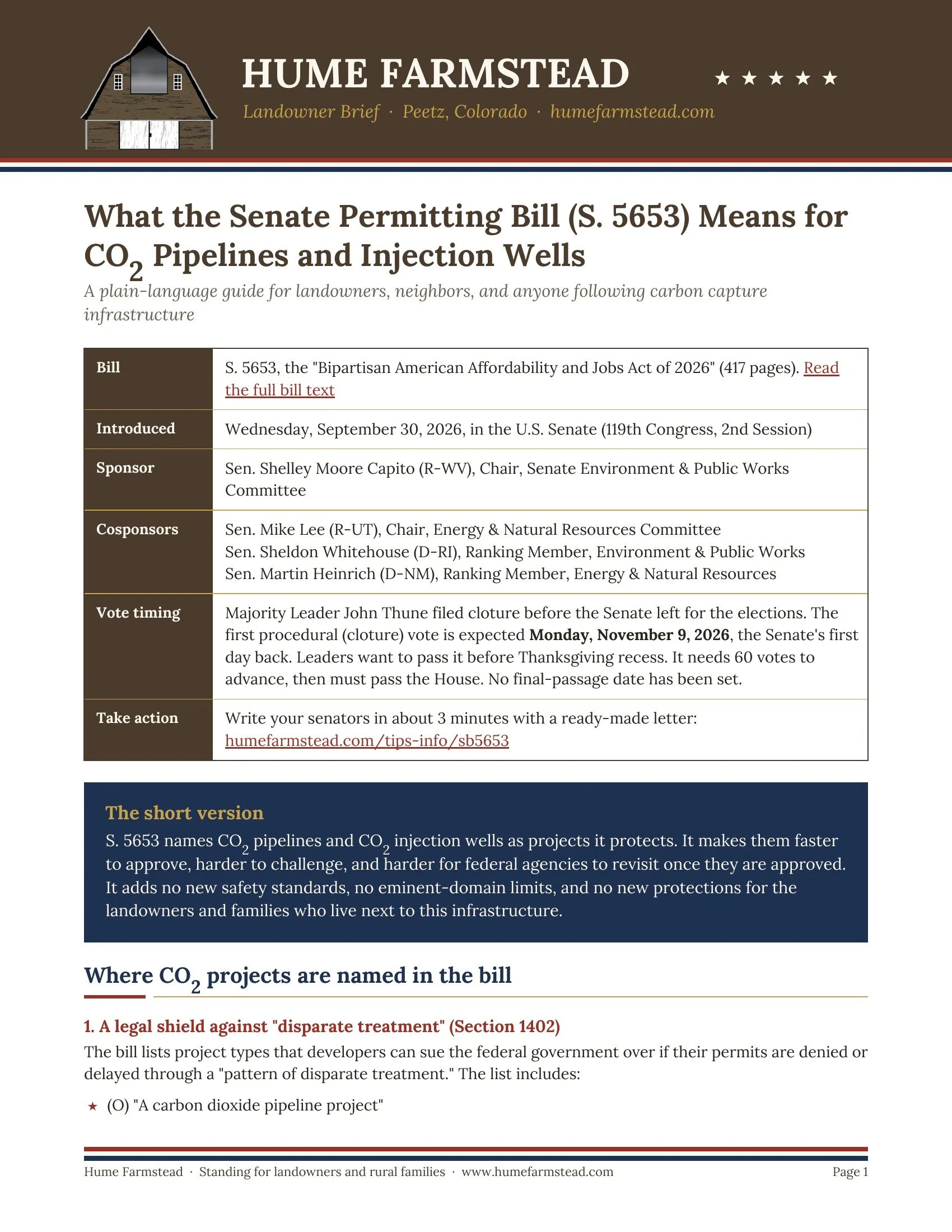
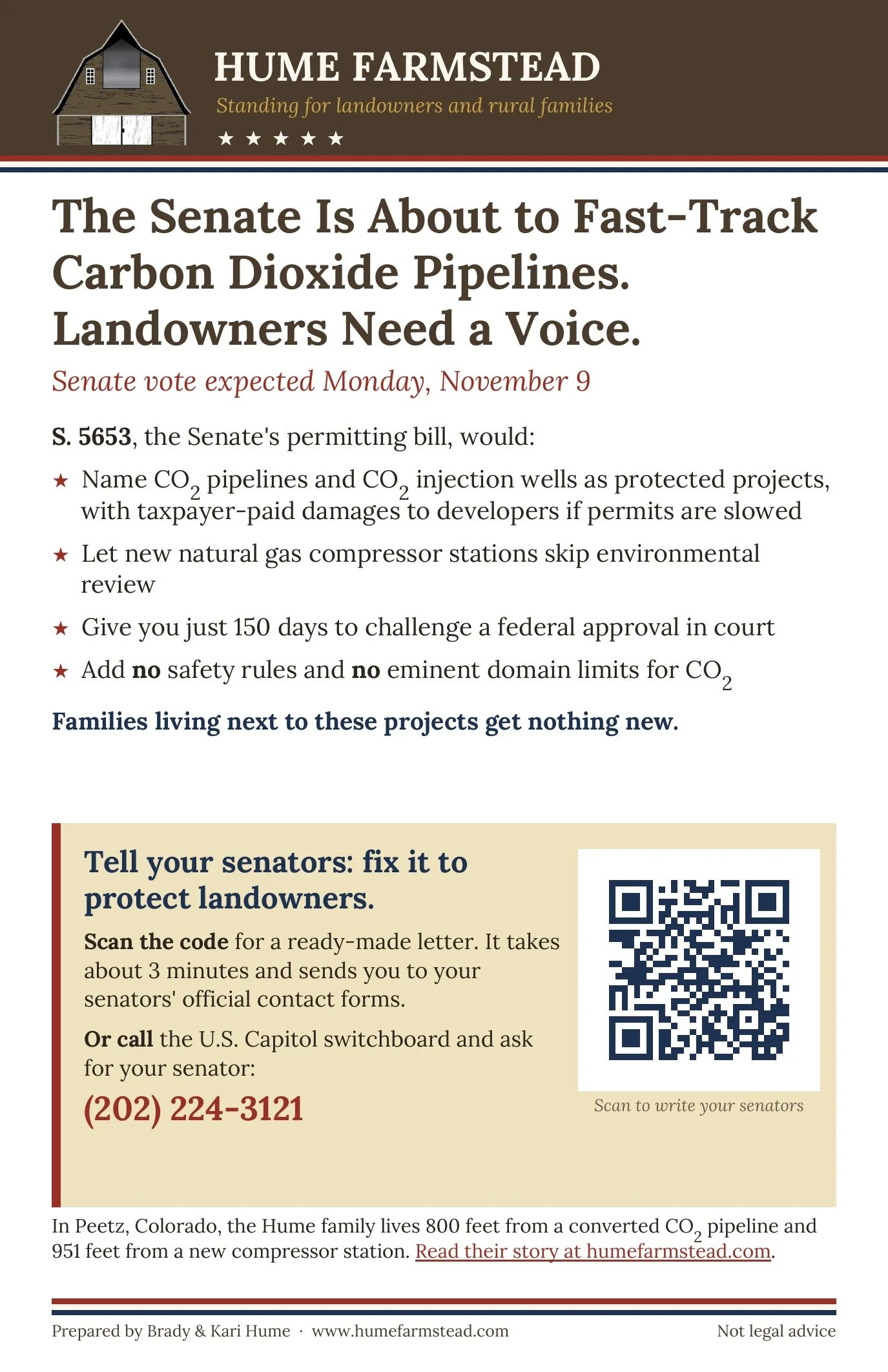
Senate bill 5653, the "Bipartisan American Affordability and Jobs Act of 2026" names CO2 pipelines and CO2 injection wells as projects it protects. It makes them faster to approve, harder to challenge, and harder for federal agencies to revisit once they are approved.
It adds no new safety standards, no eminent-domain limits, and no new protections for the landowners and families who live next to this infrastructure.
-
This is a printable and shareable format that states in plain language how the bill will impact and expand the ease of constructing and converting CO2 pipelines and injection wells, as well as it would alleviate the need for environmental review for natural gas compressor stations.
-
This simple half-page flyer is a great way to print and spread that word in your area. Consider your county meetings, grocery stores, schools, co-ops, feed stores, church, sports teams, workplace, and more.
Click to Download: 2 FLYERS PER PAGE -or- HALF PAGE FLYER
-
In no short form, the bill contains a whopping 417 pages with many implications that is GREAT for giant corporations and INCREASES VULNERABILITY for landowners and constituents.
READ THE BILL HERE: https://www.govinfo.gov/content/pkg/BILLS-119s5653is/pdf/BILLS-119s5653is.pdf
-
In 3 minutes or less, you can use our form to let your legislators know how they can best represent you as their constituent.
SCROLL TO THE BOTTOM OF THE PAGE FOR FORM
-
Download these images and send them back to this page to complete their form below, download the guide, and print flyers.
A simple message such as this can be copy and pasted to your social media pages:
ACT NOW: SB 5653 will protect projects for CO2 Pipelines and Wells (CCS) for easier permitting and more difficult litigation while adding NO NEW PROTECTIONS or oversight for that very infrastructure and the people and environment that may receive the harm.
IMAGE ONE: “Say No to Fast-Tracking”
IMAGE TWO: “Make Your Voice Heard Now”
IMAGE THREE: “Taxpayers pay the Developer”
IMAGE FOUR: “No Safety Rules”
IMAGE FIVE: “150 days to challenge”
IMAGE SIX: “Paid Twice”
Use the form below
📞
Tell your senators
📧
Use the form below 📞 Tell your senators 📧

Standing for landowners and rural families
Tell your senators: protect landowners in S. 5653
The Senate's permitting bill names carbon dioxide pipelines and CO₂ injection wells as projects it protects. It makes them faster to approve and harder to challenge, and it adds nothing for the families who live next to them. This page writes your letter for you. It takes about three minutes.
Step 1
Your information
Step 2
What you're asking for
Changes to ask for (uncheck any you don't want in your letter)
Step 3
Your letter
Step 4
Send it
Senators accept messages through the contact form on their own websites, which checks that you live in their state. Open your state's page, click each senator's name, choose Contact, and paste your letter. Send it to both of your senators.
Call instead
U.S. Capitol switchboard. Ask for your senator's office.
(202) 224-3121Your representative
The House votes after the Senate. Find your representative by ZIP code and send the same letter.
Find my representativePhone script
Nothing you type here is sent anywhere or saved by Hume Farmstead. Your letter only goes out when you paste it into your senator's own form.
Learn more
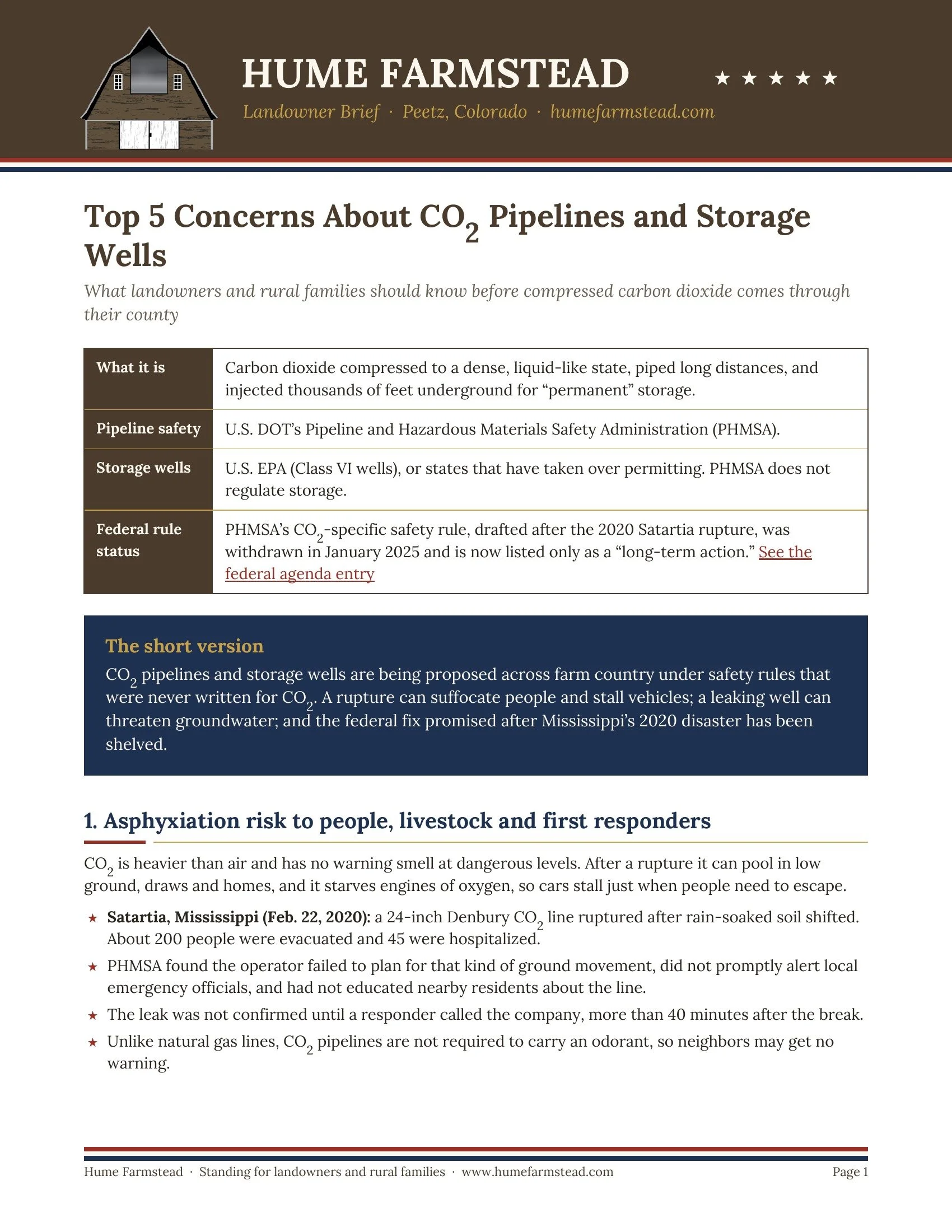
What are the primary concerns about compressed CO2 transported by pipeline or Sequestered in injection wells?
1. Asphyxiation risk to people and responders
CO₂ is heavier than air, colorless, and odorless at dangerous concentrations, so a rupture can pool in low ground and suffocate people before they know what’s happening. It also stalls car engines, which blocks escape and emergency response. The defining case is Satartia, Mississippi: on February 22, 2020, a CO₂ pipeline operated by Denbury ruptured near the community, and the rupture sent 45 people to the hospital. PHMSA found that the pipeline broke when soil movement after persistent heavy rain put strain on it, and that Denbury had failed to prepare for such natural hazards, failed to alert local emergency officials, and failed to educate nearby residents about the pipeline. The leak was only confirmed after an emergency responder called Denbury, more than 40 minutes after the rupture. Unlike natural gas, CO₂ pipelines have no required odorant, and pipeline safety experts have recommended PHMSA require one to alert the public to leaks.
2. Threats to groundwater and drinking water from injection wells
Storage wells can contaminate aquifers in two ways: CO₂ can migrate up the well bore into the aquifer at any time after injection, or pressure can force brine from the injection zone into the aquifer. That pressure reaches far beyond the CO₂ itself; researchers found that pressure effects driving leakage through old boreholes and faults could extend many kilometers from the injection site, much farther than the CO₂ plume. Old, poorly plugged oil and gas wells are the main weak point, a big issue in a region like ours with decades of drilling history.
The real-world example is ADM in Decatur, Illinois, the nation’s first commercial sequestration site. EPA found ADM violated the Safe Drinking Water Act when a monitoring well leaked liquified CO₂ into unauthorized zones; the leak was detected in March 2024, though the company had known about tubing corrosion since October 2023. Roughly 8,000 metric tons of liquid CO₂ and other fluid leaked. ADM then found a second leak and paused injections, and reporting later revealed two dozen other wells nearby that could allow CO₂ fluid to travel toward drinking water supplies. Afterward, EPA told Class VI permit applicants that a steel alloy and a type of cement commonly used by industry are not suitable for these wells in most instances, particularly where water and CO₂ are both present. To be fair, the leaked CO₂ stayed about 5,000 feet down, well below the area’s groundwater, but the case shows corrosion happens, and residents weren’t told.
3. Damage to soil, crops, and livestock
A leak from a buried line or a failing well displaces oxygen in the root zone and acidifies soil. In a University of Nottingham field test, germination of winter beans in CO₂-gassed plots was severely hindered and the final crop stand was cut in half, pasture grass showed stress and significantly reduced biomass, injected CO₂ displaced oxygen from the soil, and soil pH dropped. A long-term natural leak site in China showed pH fluctuation, reduced nitrogen and phosphorus, and harm to plant growth and wheat crop quality at high CO₂ flux. For livestock, the same asphyxiation risk as for people applies, especially in low-lying pastures and draws.
One honest caveat for your materials: some studies find soil recovers within weeks after a small leak stops, so the strongest argument is about undetected, prolonged leaks and the lack of required monitoring on farmland.
4. Weak and shrinking federal oversight
This is arguably the strongest point right now. After Satartia, PHMSA drafted CO₂-specific rules, but the proposal was withdrawn after it was never published in the Federal Register, under a January 2025 memorandum instructing agencies to withdraw unpublished rules. The current federal agenda lists the CO₂ pipeline rule under “Long-Term Actions”, meaning no near-term action. Meanwhile, in April 2026 PHMSA proposed narrowing the definition of a pipeline “incident”, and its spring package included raising incident and accident reporting thresholds, which would mean fewer leaks on the public record.
Other gaps: regulations for assessing a CO₂ rupture’s potential impact area were not developed specifically for CO₂, and PHMSA does not regulate long-term CO₂ storage facilities, which fall to EPA or state agencies. Even industry wants clearer rules: in February 2026, the Carbon Capture Coalition urged PHMSA to issue updated CO₂ pipeline safety guidelines.
5. Landowner rights and long-term liability
Projects in the Midwest have faced resistance from landowners concerned about operators using eminent domain to condemn land, and the Illinois Farm Bureau, while not opposed to CO₂ pipelines, is against using eminent domain for them. Storage is meant to be permanent, but companies, tax credits, and owners change. Key questions to raise: who pays if a well leaks 30 or 80 years from now, whether liability transfers to the state (and taxpayers) after closure, and whether landowners above a CO₂ plume ever consented to their pore space being used. The ADM case also showed that residents can be the last to know; a Decatur city councilman learned about the leak when the rest of the world did.
A point opponents will raise: PHMSA data showed the 2020 per-mile incident rate for CO₂ pipelines was about half that of crude oil pipelines. One response is that the existing network is small and mostly in remote oilfields, and the buildout now proposed runs through farm country and near towns under rules not written for CO₂.
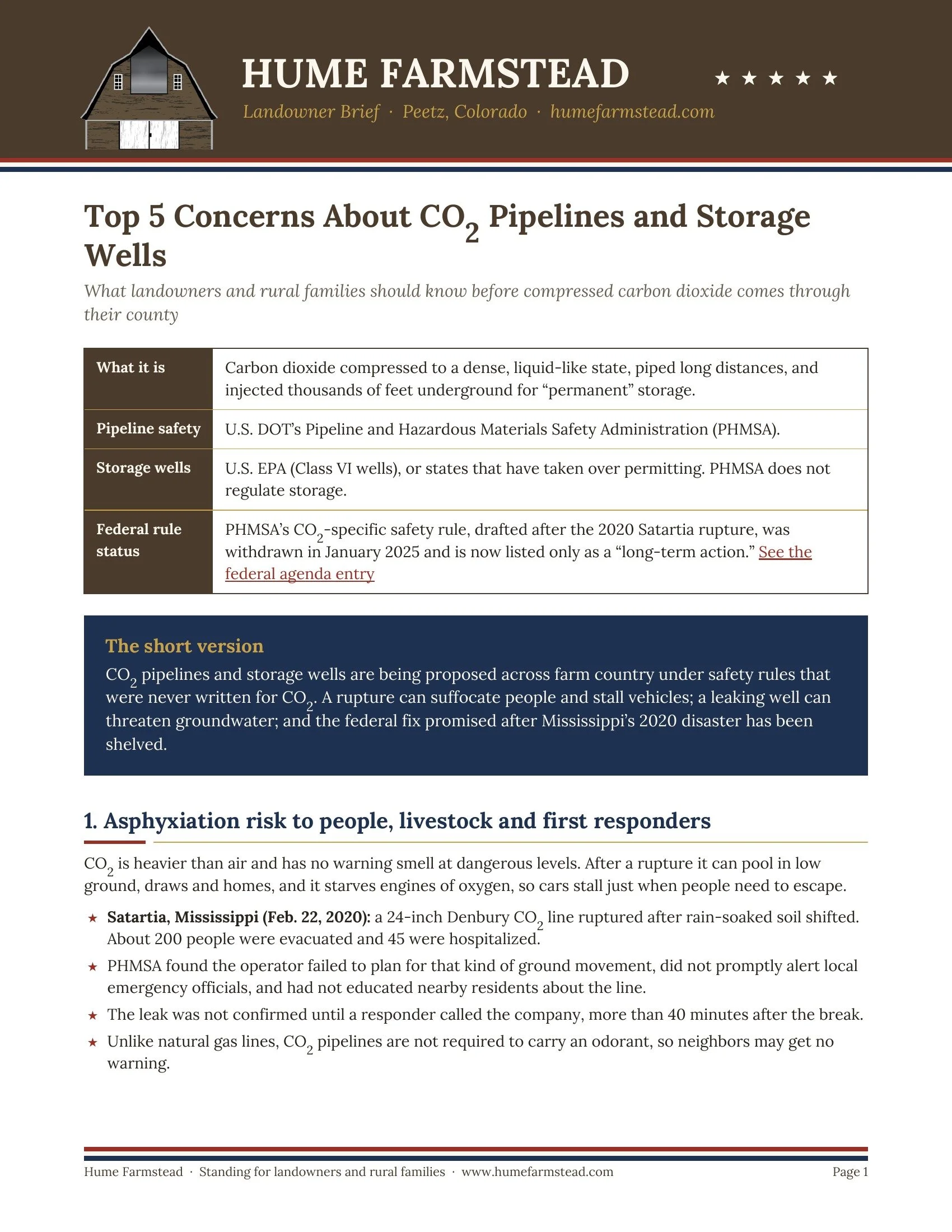
Download this information as a printable 2-page guide