UPCOMING MEETING: Tuesday November 16th, 7:00pm
Logan County, Colorado Planning Commission will be having a meeting at the Courthouse to review the Regulations for Logan County Carbon Sequestration Facilities.
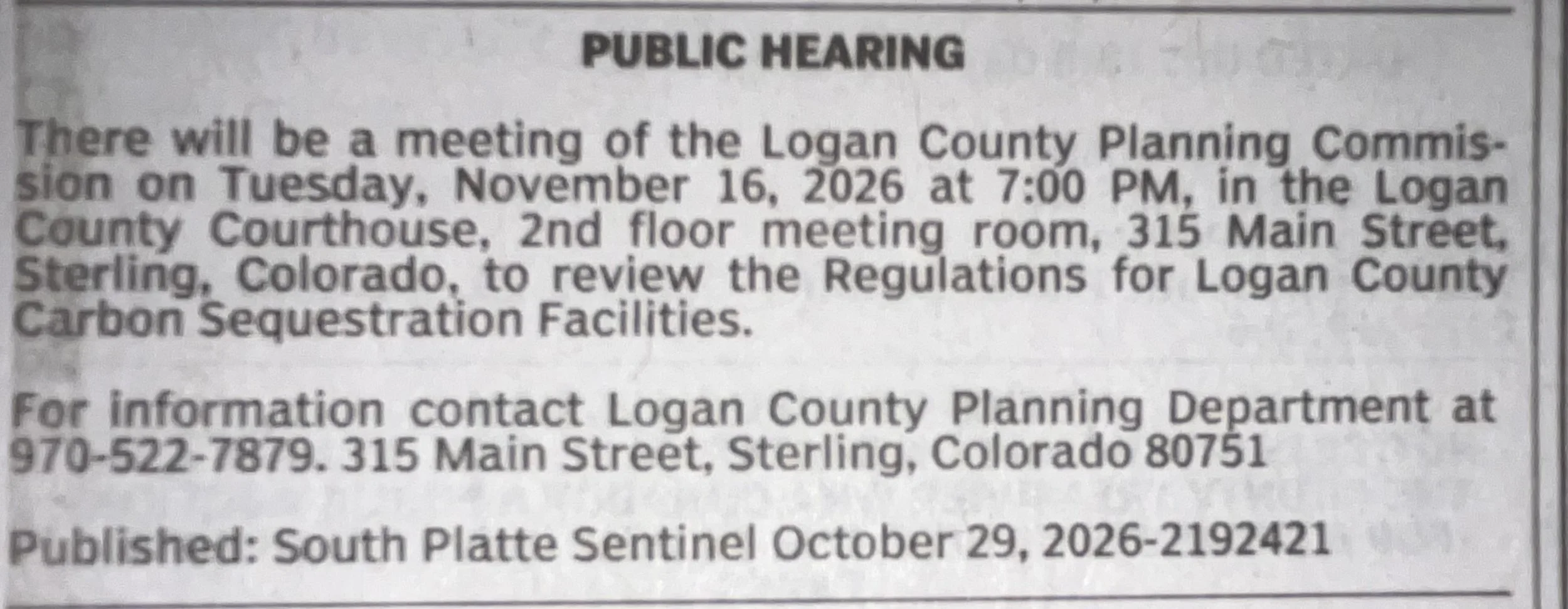
Excerpt from the Sentinel newspaper, Thursday October 29, 2026
This page is to share suggested regulatory inclusions and provide information and ideas to other county residents. CLICK HERE to see what we (The Humes) sent in to the Commission.
We are thankful to the Logan County Commission for adopting a carbon sequestration moratorium through April 6, 2027, Resolution 2026-32. We are asking the County to extend the moratorium 18 months, to October 6, 2028, so Logan County can see how other communities, their water and land, and their emergency responders fare as this mostly unregulated and little-studied technology is built out elsewhere first.
Colorado law says county land-use rules for these operations may be stricter than the state's. We ask the County to use that time to adopt a carbon sequestration facilities resolution and 1041 designations, built on the safety framework PHMSA drafted in January 2025 but never published and on the lessons other states have already learned.
Why now?
Logan County is seeing an influx of interest in carbon sequestration pipelines, class VI injection wells, and pore space leasing as we speak. Also, Colorado takes over Class VI CO2 well permitting on November 12, 2026; the converted Trailblazer CO2 pipeline is already operating in Logan County; and the federal CO2 pipeline safety rule was withdrawn before it was ever published. The Senate is considering the BAAJA bill that will only make these pipelines and wells easier to implement with no new protections to landowners and residents.
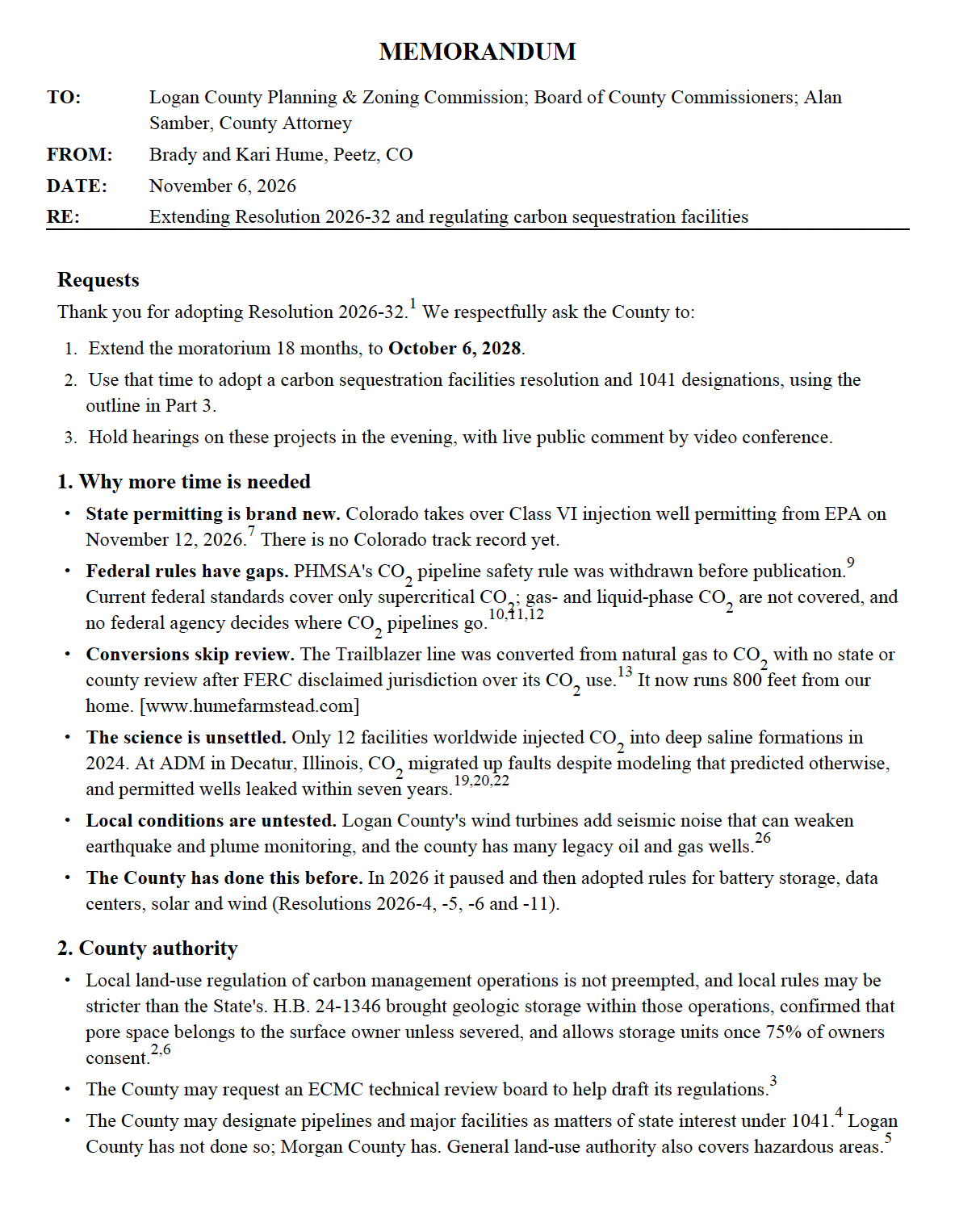
CLICK TO DOWNLOAD - this is what we sent to the Commission
RECOMMENDED REGULATION
A. All facilities
County permit after public hearing for CO2 pipelines, conversions of existing pipelines, Class VI injection and monitoring wells, flow lines, mainline valves, compressor and pump stations, and storage-site surface facilities.
Complete applications: site plans, a legally created parcel, and proof that easements expressly cover CO2.
Certified-mail notice to every owner and resident within at least two miles on each side of a pipeline or surface facility (or the modeled impact zone, if larger), and over the full projected plume and area of review for storage; evening hearings with video comment.
Applicant-paid independent engineering, geology and legal review.
Financial assurance fully funded before operation, payable to the County and covering neighbors' losses (wells, property, crops, livestock, business).
B. Pipelines, including conversions
A two-mile notice and planning zone, matching PHMSA's draft emergency planning zone, mapped and recorded.
Site-specific release modeling using local terrain and wind.
Treat any conversion as a new use: file construction, inspection and enforcement history, plus new pressure testing, coating and corrosion surveys, and in-line inspection results.
Operator-funded equipment and training for fire and EMS, and an automated "reverse 911" system to alert residents of a release.
Road-crossing permits (bored, not cut), a County inspector paid by the operator, 48 inches of cover in farm ground, and restoration bonds.
C. Valves and compressor or pump stations
Setbacks from homes; vapor detection tied to "reverse 911" alerts; noise and lighting limits; advance notice of blowdowns; siting that accounts for prevailing winds; removal bonds.
D. Class VI wells and storage
Setbacks from homes, schools and water wells, treating the State's 2,000-foot minimum as a floor.
An inventory of legacy wells in the area of review, with proof each is properly plugged.
Baseline and ongoing testing of nearby private wells (pH, manganese, iron, calcium, uranium, barium).
Fault-slip analysis, injection pressure capped below fault-slip pressure, and numeric triggers to slow or stop injection after earthquakes, as EPA's own guidance contemplates.
Monitoring proven to work with nearby wind turbines running (noise study, borehole sensors), with one year of baseline data.
Far-field pressure monitoring and combined modeling of every regional storage project; ground-uplift monitoring.
Notice to the County and neighbors within 24 hours of any well-integrity problem or monitoring anomaly.
E. Pore space and growth
Proof of pore-space agreements or a final ECMC unit order covering the full plume, with the plume map recorded.
Notice to every owner in a proposed storage unit, including non-consenting owners, and County participation in ECMC hearings.
Buffer zones around towns to protect future housing and business growth.
Documented risks
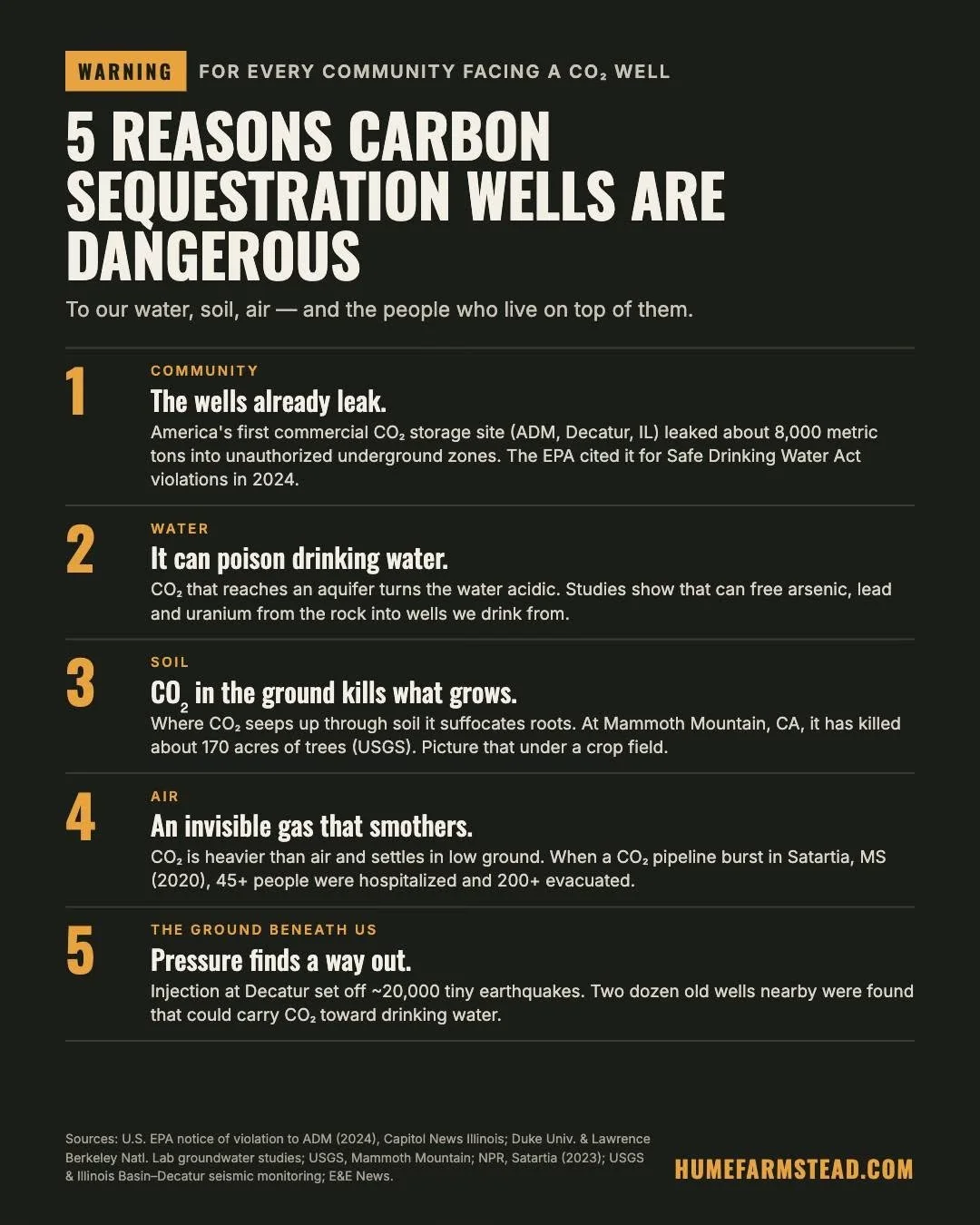
Asphyxiation. CO2 is heavier than air and invisible. NIOSH lists 40,000 ppm as immediately dangerous to life. PHMSA found large lines can exceed 30,000 ppm about two miles from a rupture.
Satartia, Mississippi (2020). About 200 people evacuated and 45 sought hospital care; the operator's model underestimated the affected area and local responders were not notified.
Leaks go unnoticed. Of 121 CO2 pipeline accidents, automated systems caught under a quarter and the public reported 17%; valves were the most common source, and risk rises again after 30-40 years of service.
Storage leaks. About 8,000 metric tons of CO2 and fluid migrated into unauthorized zones at ADM; EPA issued a notice of violation, and most residents learned of it from the news.
Drinking water. In laboratory tests that included Ogallala aquifer sediments, CO2 exposure raised some metals more than a hundredfold, at times above EPA limits.
Reach. Modeled pressure from multiple projects spread up to 200 km, and neighboring sites interfered with each other.
Cleanup. After a 2016 gas-storage leak into Illinois' Mahomet Aquifer, families used bottled water for years; the settlement brought $575,000 in penalties, and taxpayers funded much of a new water line.
Compressor stations emit pollutants linked to respiratory and heart disease.
References
Logan Cnty. Bd. of Cnty. Comm'rs, Res. 2026-32 (Oct. 6, 2026), as amended; Minutes (Oct. 6, 2026).
Colo. Rev. Stat. §§ 24-65.1-101 et seq.
H.B. 24-1346, 74th Gen. Assemb., 2d Reg. Sess. (Colo. 2024).
Approval of Colorado's Underground Injection Control Class VI Program, 91 Fed. Reg. 64,780 (2026) (eff. Nov. 12, 2026).
Colo. Energy & Carbon Mgmt. Comm'n Rules, 2 Colo. Code Regs. 404-1 (Class VI geologic storage); ECMC, ECMC Adopts Carbon Storage Rules.
PHMSA, Pipeline Safety: Safety of Carbon Dioxide and Hazardous Liquid Pipelines, NPRM, RIN 2137-AF60, Docket No. PHMSA-2022-0125 (pre-publication version Jan. 10, 2025) (withdrawn; never published), at 105-06 (proposed 49 C.F.R. §§ 195.5, .210(c), .248, .263, .402, .456, .579).
49 C.F.R. § 195.2 (definition of carbon dioxide).
Trailblazer Pipeline Co., Order Issuing Certificate and Granting Abandonment, Docket No. CP22-468-000 (FERC Oct. 23, 2023); Environmental Assessment (Apr. 2023) §§ A.3, A.5.5.
Couser v. Shelby County, Iowa (8th Cir. June 5, 2025), cert. denied; summary.
U.S. EPA, UIC Class VI Well Site Characterization Guidance, EPA 816-R-13-004 (2013); Public comments, EPA Docket No. EPA-R05-OW-2026-6569 (One Earth Sequestration) (Sept. 2026), incl. Eco-Justice Collaborative.
PHMSA, Failure Investigation Report: Denbury Gulf Coast Pipelines, Satartia, Mississippi (May 2022).
NIOSH, Immediately Dangerous to Life or Health Concentrations: Carbon Dioxide.
U.S. EPA Region 5, Notice of Violation to Archer Daniels Midland Co. (Aug. 2024); Capitol News Illinois (Sept. 2024).
Schueler, Saltzer & Benson, Accident Analysis of CO2 Pipeline Failures: Patterns, Detection, and Consequences (2026).
People ex rel. Raoul v. Peoples Gas Light & Coke Co., No. 17-CH-218 (Ill. Cir. Ct. Champaign Cnty.) (consent order June 29, 2022); Illinois Public Media (July 27, 2021).
Limberger et al., Predicting the Seismic Signals Generated by Wind Farms, 12 Sci. Rep. (2022); Limberger et al., 14 Solid Earth 859 (2023).
Nordhaus & Pitlick, Carbon Dioxide Pipeline Regulation, 30 Energy L.J. 85 (2009).